
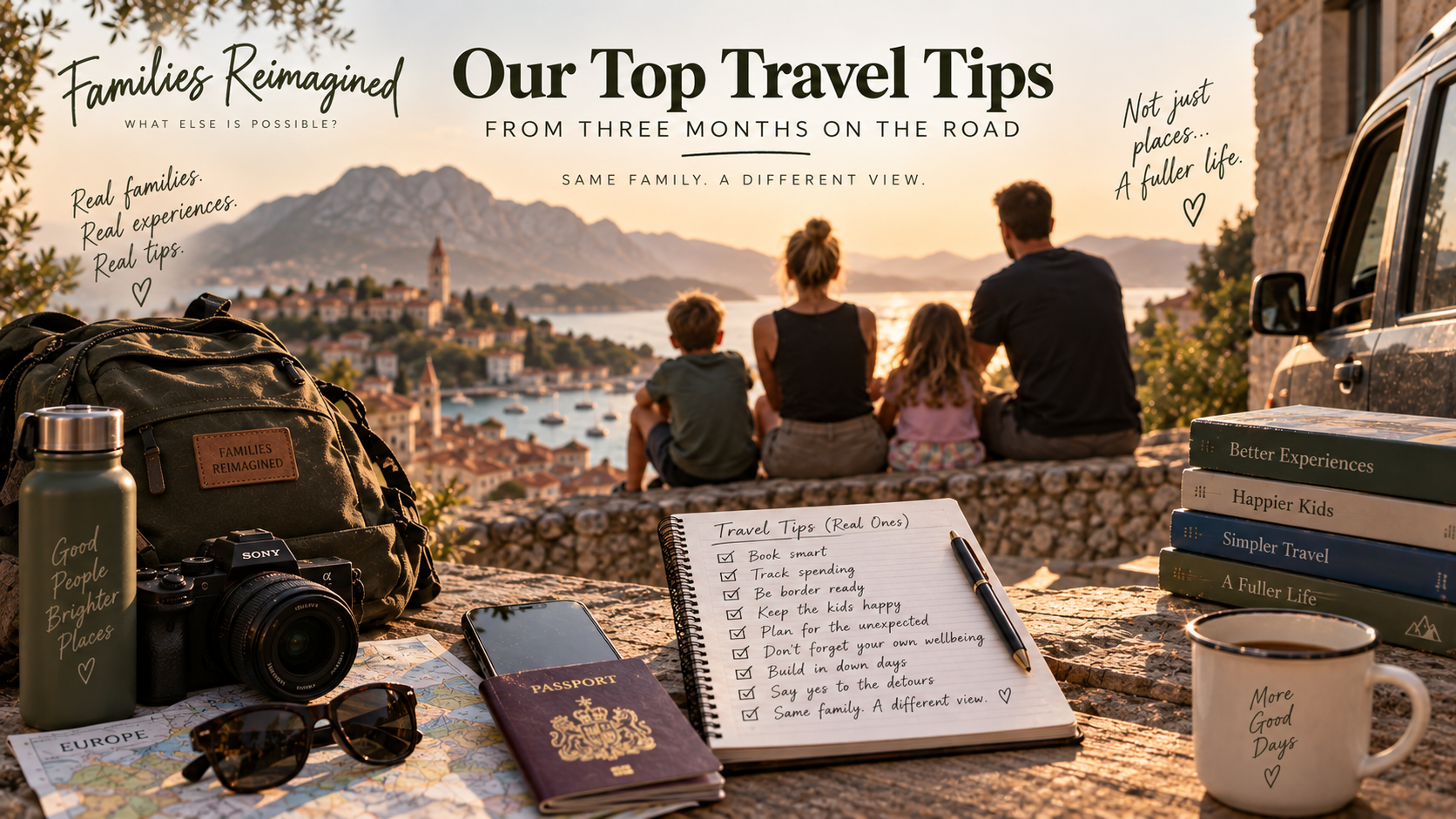
Ben and Claire pull together the practical lessons that have actually made a difference across their first three months of full-time family travel, updated as they learn more.
Three months and twelve countries in, a few things have come up again and again, sometimes learned the easy way, sometimes the hard way. Here’s everything we’d genuinely tell another family before they set off.
Booking and money
Book accommodation last-minute where you can. We’ve had real success booking after a property’s check-in time (around 3pm), when unsold rooms often get discounted on the spot. It’s meant genuine savings more than once, including a luxury apartment in Krakow that dropped from £180 to £110 simply by booking on the day.
Track spending daily, not weekly or monthly. It’s the only way to see clearly which decisions, a themed restaurant, a paid attraction, actually moved the number, rather than being left guessing at the end of a longer stretch.
A kitchen isn’t automatically the answer, but it usually helps. Some of our cheapest stops had no kitchen at all, because eating out itself was simply inexpensive there. But where we’ve had a kitchen and used it, it’s made a real, direct difference to cost.
Budget for motorway tolls if you’re driving through Italy. They add up fast on a longer drive and are easy to underestimate if you’re not expecting them.
Driving and borders
Cross borders early in the day if there’s any history of queues. We saw people waiting up to five hours crossing into Montenegro later in the day; crossing early ourselves took about thirty minutes.
Don’t assume a border will be difficult just because a country’s reputation suggests it should be. Some of our smoothest, most invisible crossings were the ones we expected the most hassle from.
Keep documents easily accessible, not buried in luggage, passports, car registration, green card, especially for any crossing that might involve checks.
For long driving days, over-prepare rather than under-prepare. Snacks, activities, travel sickness tablets if anyone in the family needs them. It’s made a genuine difference to how well our children handle a full day in the car.
Photograph everything immediately if something goes wrong at a petrol pump or any unmanned payment machine. The pump itself, the display, the timestamp, your own fuel gauge. It made resolving a failed payment with the bank far faster than it would otherwise have been.
Family and kids
Ask your children directly what would make an occasion feel special, rather than assuming. When it came to a birthday on the road, a simple, direct question gave us a clear, achievable list to work from, rather than us guessing at what would matter to him.
Plan ahead for anything you can’t easily replace in the moment, gifts, cards, small comforts. We’ve picked things up weeks in advance more than once, simply because we happened to find them, rather than leaving it all to the last minute.
Build in genuine down days, especially after a fast-moving stretch. Moving through several countries quickly in one go is tiring, mostly the sheer amount of driving, and we’ve learned to recognise when the family needs a day of doing nothing rather than pushing on.
Check specifics like height restrictions or age limits before booking a family activity. We’ve been caught out by both, worth confirming directly rather than assuming.
A shared routine travels well, even without a fixed home. Consistent bedtimes, a settle-in ritual at each new stop, familiar comforts from home, all of it has helped our children feel steady even as the location keeps changing.
Expect your own routine to slip sometimes, and don’t be too hard on yourself when it does. Arriving late, skipping the reading, small pieces of a normal rhythm can quietly lapse on a heavy travel day. It’s not a failure, it’s a sign worth listening to if it starts happening a lot.
Match how long you stay to what a place can actually offer. For us, most European city breaks gave everything they had within three to five days, longer than that and the children started to lose interest. Knowing that in advance would have saved us second-guessing our own pace.
Health, routine, and staying grounded
Don’t let fitness become the first thing to drop. We’ve kept exercising throughout, even without regular gym access, running, bodyweight training, whatever’s available locally. It’s made a real difference to how we all feel, not just physically.
Getting lost isn’t always a bad thing. More than once, a wrong turn has led to one of the best unplanned moments of a stretch. Build in enough slack in your schedule that a detour doesn’t feel like a disaster.
Trust, with sensible caution, has served us better than we expected. Strangers have repeatedly gone out of their way to help us, a shared phone hotspot, a kind host, a thoughtful guide. We still check reviews and trust our instincts, but we’ve stopped assuming the worst by default.
Know the difference between travelling and holidaying, and plan for both. Constant movement is tiring in a way a normal holiday never is, and after a fast stretch, we’ve learned to deliberately book somewhere static, all-inclusive if it suits, purely to switch off rather than explore. It’s not admitting defeat, it’s part of making a longer trip sustainable.
If a region rewards longer stays, build that in from the start rather than defaulting to constant movement. City breaks and slower, more immersive regions ask for different paces. Matching your itinerary to the place, rather than a fixed rhythm everywhere, has made a real difference to how settled we’ve all felt.
Wellbeing and self-care
Alone time is possible even when you’re together constantly, it just needs deliberate space. In multi-room accommodation, we’ve found everyone naturally drifts to their own corner for a while, and even an hour apart is usually enough for everyone to feel ready to reconnect.
A simple sensory exercise can settle an overwhelmed or overtired child fast. Asking them to name five things they can hear, five they can smell, five they can see brings them back into the moment and gives them something concrete to focus on instead of whatever’s upsetting them.
Protect sleep hygiene as much as your accommodation allows. A dark, quiet, cool room, a consistent bedtime, and no devices in the evening have made a real difference, even when sharing one room as a family makes it harder than it would be at home.
Check in with each other properly, not just when it’s obvious someone needs it. Noticing signs after the fact isn’t the same as asking directly and regularly. It’s something we’re actively working on getting better at.
What else is possible when the lessons from the road become as valuable as the places themselves?
FAQ
What’s the single biggest money-saving tip from your first three months? Booking accommodation last-minute, particularly after a property’s check-in time, has consistently saved us the most.
What’s the most common mistake to avoid when driving through multiple countries? Underestimating how tiring frequent border crossings and long driving days are, especially for children. Build in rest days rather than moving constantly.
Is it worth trusting strangers while travelling with children? In our experience, yes, more often than we expected. Sensible caution still matters, but we’ve found kindness far more often than risk.
Do you ever need a break from travelling itself? Yes, and we think that’s normal rather than something to feel guilty about. Constant movement has its own kind of tiredness, and building in genuinely static, low-decision stretches has made this life far more sustainable for us.
How do you get personal space when you’re travelling as a family full-time? It depends on the accommodation and how long you’re staying, but even small, deliberate pockets of alone time, an hour here or there, make a real difference to everyone’s mood and patience.
Related reading:
Leave a Reply