
Three months and twelve countries into full-time family travel, Claire tackles a question she suspects will ruffle a few feathers: even when this is the life you chose, sometimes you need a break from it.
We’re exactly three months into this trip now, and we’ve just booked two weeks somewhere we don’t have to think about a single logistic. I know how that might land. To a lot of people, what we’re doing already looks like one long holiday, so the idea that we’d need a holiday from it might sound strange, or even a bit ungrateful. But travelling and holidaying are not the same thing, and I think that distinction is worth spelling out clearly.
What we’ve actually covered
Twelve countries in three months, and within several of those, more than one location. But that number hides an important detail: the first four weeks were static, a full month settled in one spot in Spain, deliberately, to ease into this life slowly. It’s really only the last eight or nine weeks where the pace has picked up, moving through countries every few days, sometimes just one night before moving on again.
Why moving fast is tiring in a way a holiday never is
When you’re only somewhere for a short stretch, the instinct is to see as much as you possibly can while you have the chance. That means squeezing more in, not less, and it means very few genuine down days. We’ve had the odd one, but they’ve been rare across this faster stretch.
That pace catches up with you. It’s not dramatic, nobody’s collapsing from exhaustion, but there’s a real, cumulative fatigue that comes from constantly packing, unpacking, adjusting to somewhere new, working out where things are, over and over again. A holiday gives you a base and lets you explore from it. Travelling like this often means the base itself is what keeps changing.
When accommodation doesn’t match the dream
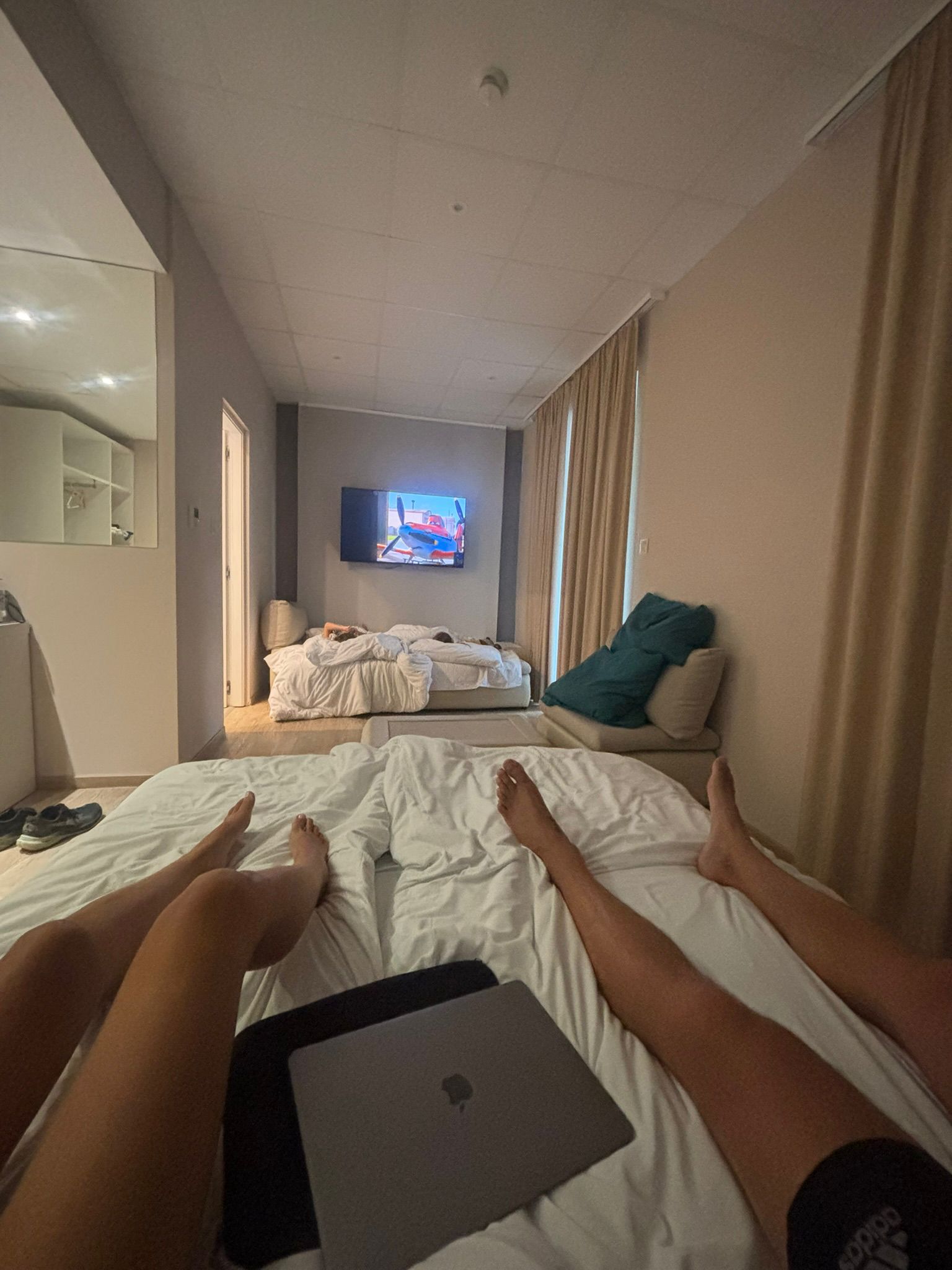
Not every place we’ve stayed has given us that settled, at-peace feeling. I’m not expecting five-star luxury everywhere, that was never the point of this. But I do want to feel relaxed somewhere, and that hasn’t always been the reality. Some accommodations have looked nothing like their photos once we arrived. Some have had far less space than we needed, occasionally meaning the children have had to share a bed, which adds its own quiet pressure to a stay that’s already asking a lot of everyone.
The budget is always in the room
We don’t have endless funds, and we’re honest about that. Every stop involves some level of thinking about cost, what we can afford, what represents good value, what we’re willing to compromise on. That’s simply part of choosing this life over the version with a fixed income and a fixed home. It means not every destination or every stay is our genuine first choice, sometimes it’s the sensible choice within what we’ve got. A holiday, by contrast, tends to switch that calculation off entirely, at least for its duration.
Why we booked two weeks in Tunisia
By this point, three months in, all of us had quietly reached the same conclusion: we needed a break from travelling itself. Somewhere to stay put, fully switch off, not think about where we’re sleeping tomorrow or what today’s spending looks like.
Leaving the Schengen area for a while was already on our to-do list regardless, the 90-day rule meant we needed to be outside it soon anyway. So we booked two weeks all-inclusive in Tunisia, on-site everything, a kids’ club, activities, facilities, nothing to plan, nothing to budget hour by hour. It’s not really about the destination this time. It’s about giving all four of us somewhere to rest, think, and simply stop moving for a while.
The distinction, stated plainly
Holidaying is stepping outside your normal life for a defined stretch, everything arranged, everything paid for, a clear end date to return to normal. Travelling, the way we’re doing it, is our normal life right now. It has its own routines, its own budget, its own logistics, and its own kind of tiredness that a fortnight’s holiday doesn’t carry. Needing a break from it doesn’t mean we’ve made the wrong choice, or that we’re not grateful for it. It just means it’s real life, lived somewhere different, and real life needs rest sometimes too.
Routine is the first thing to slip
One thing this pace has taught me about myself: I’m someone who thrives on structure at home, and travelling this way can genuinely contradict that. Some days it’s simply hard to stick to our usual routine, arriving late somewhere, the reading with the children not happening, small pieces of our normal rhythm quietly lapsing without us really deciding to let them. It’s not a huge failure each time it happens, but I’ve noticed I’m craving that structure back, more than I expected to.
What this stretch has taught us going forward
Looking back, the reason we’ve moved so quickly through Europe makes sense on its own terms. A lot of the places we’ve visited are essentially city breaks, and beyond three, four, five days, there’s genuinely not much more to see, and the children start to feel like they’ve overstayed a place that’s stopped holding their interest. Moving on made sense for where we were.
But it’s shown us something important for what comes next. In other parts of the world, we want static points, real, longer stays rather than another string of quick hops. We’ve already built that in: a full month booked in America at the end of that leg of the trip, and when we reach the Far East, we’re planning longer, more settled stays too, particularly in places I’ve visited before and already know we love, Bali, Vietnam among them. Europe taught us how we move. What comes next is about learning how we rest.
What longer stays will actually give the children
Right now, our children are constantly meeting new people, new adults, new kids their own age, and their communication skills have grown noticeably because of it, asking questions, striking up conversations, none of that fazes them the way it once might have. That part has genuinely been a gift of moving quickly.
But what they haven’t had yet is time. The chance to know the same cafe, the same faces, the same people, well enough to build something more personal than a passing hello. That’s what longer stays will give them that constant movement hasn’t been able to, and it’s something we’re actively planning for as we head further afield.
Where we are now
Europe, for us, is coming to a close. We’ve got about three weeks left on this leg: two weeks in Tunisia, then a week travelling back through Europe towards the UK before the next chapter begins.
What else is possible when even a life you chose deliberately still needs its own kind of holiday?
FAQ
Isn’t full-time travel basically just an extended holiday? Not in our experience. A holiday has a fixed budget, a fixed end date, and nothing to plan. Travelling like this is our actual daily life, with its own routines, costs and decisions to manage continuously.
How do you know when it’s time to slow down? For us, it built gradually, growing fatigue, fewer moments of feeling settled, more background stress about logistics and cost, until it became obvious we all needed a real pause.
Do you feel guilty admitting you need a break from this life? A little, we know how fortunate we are to be doing this at all. But needing rest doesn’t cancel out gratitude, the two can be true at the same time.
Related reading:
- Do I Miss Home?
- Three Countries, One Week: Serbia, Budapest and Slovakia
- Our Top Travel Tips From Three Months on the Road
Leave a Reply