
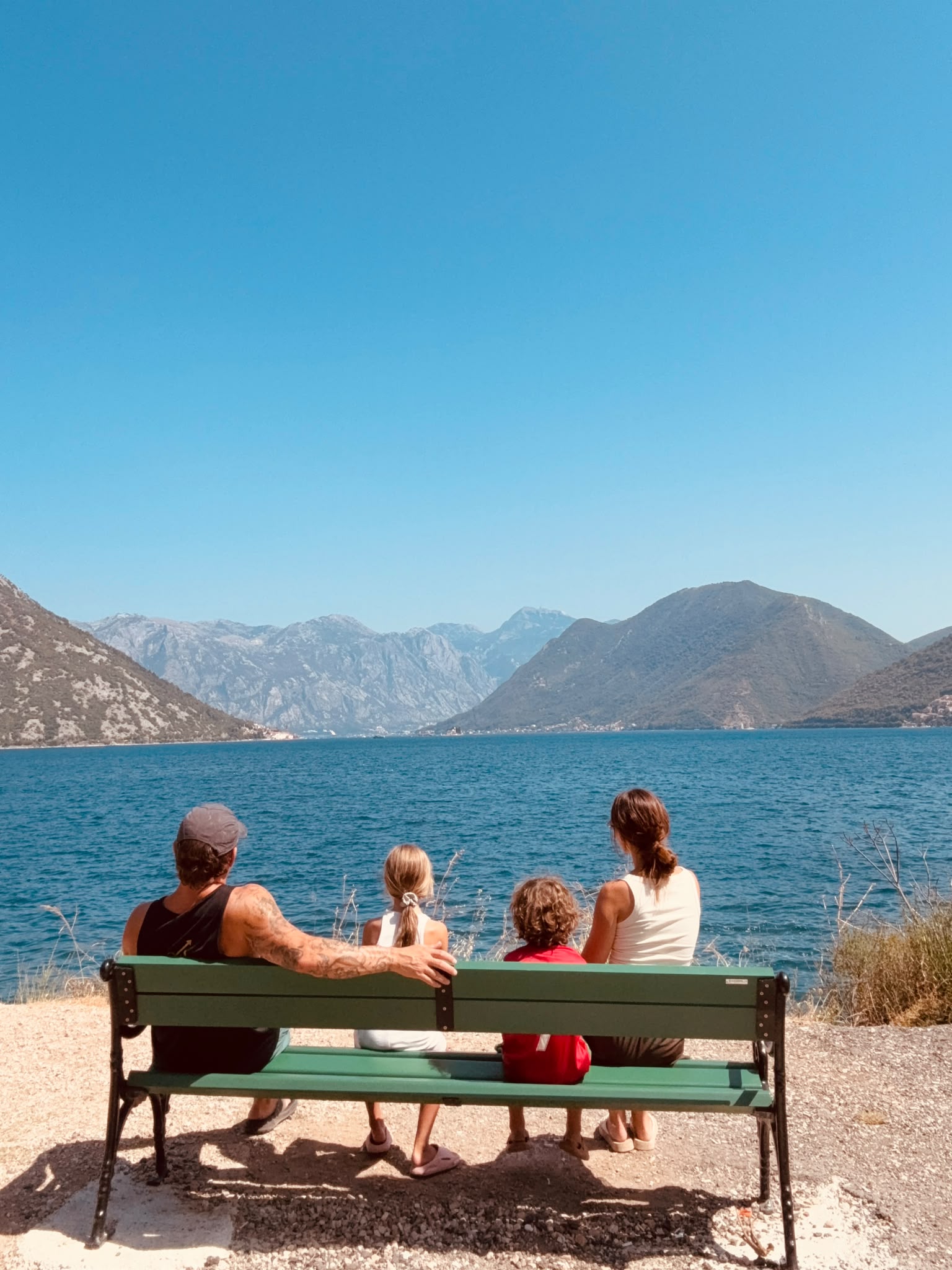
Leaving home with children raises countless questions, but the biggest one is often the simplest: how will they cope? In this article, Ben and Claire share how they prepared their children for a year of travel and the routines that have helped them feel safe, settled and excited along the way.
When families ask us about this life, the question underneath most of their questions is really about the children. Not the visas, not the money, not the schooling paperwork. What they actually want to know is simpler than that: are the kids okay?
So this one is just about them.
Why we felt the timing was right
Our daughter is seven and was in Year 2 when we left; our son is five and was in Year 1. Both were meeting or exceeding expected standards at school in reading, writing and basic maths, and their reports were consistently good. That mattered to us. It meant we weren’t pulling them out of anything they were struggling with, and it gave us real confidence that keeping on top of their basic skills ourselves, alongside the learning that travel naturally brings, wouldn’t leave them behind.
They’re different children in almost every other way. Our daughter is very much a girl’s girl: she loves nice things, loves her friends and family, loves creating things, and throws herself into learning. Our son is our wild child, active, busy, always needing to be stimulated, though every bit as affectionate underneath it, still loving a cuddle. What they share is a love of being outdoors, active and exploring, which reflects how we live as a family generally. It’s something we’ve always wanted to pass on to them, not just talk about.
What planted the seed
Last year we took the children on a six-week trip to the Far East, and it changed something in all of us. They met families living in very different circumstances to their own, and we watched it genuinely open their eyes: to different ways of living, to how fortunate they are, and to the idea that they can share and give to others who have less. That experience gave us the push toward doing what we’re doing now. Seeing how much they benefited from encountering other ways of living made the decision for this longer trip feel less like a risk and more like a natural next step.
Telling them, and what happened next
At the beginning of this year, we told the children we were planning to go travelling for at least a year, leaving the UK behind. They both handled it well, and were genuinely excited, though we suspect at that age they related to it more as an extended holiday than the bigger, longer change it actually was. There was sadness too: they said they’d miss grandma and granddad, and some of their family and school friends, but the excitement outweighed it. From that point on, they counted down the sleeps until we left.
We involved them properly in the process rather than shielding them from it. When we packed up the house, they helped sort their own bedrooms and toy rooms: what to give away, what would go into storage, what would come with us. We gave each of them their own travel case and let them fill it with whatever mattered most, not the most valuable things, just the things that would make them feel at home. Teddies they couldn’t sleep without, a few games, some books, some of their favourite toys.
It made them part of the decision rather than something that was simply done to them, and it also gently taught them something about what they actually need versus what they don’t. The toys they still loved went into storage. The things they’d outgrown, they chose to give away to other children.
What the school did for them
Their school could not have been more supportive. On the last day, in a full assembly, their teachers presented them with a travel teddy bear, which the children have named and brought with them ever since, taking photos with it in every new location. Their classes had also printed a class photo for each of them, signed by every child and teacher with their own messages.
Both children have kept these as something precious. It’s a small thing, in the scale of everything else in this story, but it’s stayed with us: a school choosing to send two children off with something to hold onto, rather than just a goodbye. Friends and family were generous in their own way too, sending the children off with gifts of things they might need for travelling, and even some currency for the places we were heading to first. Everybody, it turned out, wanted to be part of sending them off well.
The day itself
Leaving was harder for the children than we expected, but not for the reason we’d anticipated. It wasn’t the travel itself that upset them; it was saying goodbye to grandma and granddad, who came to see us off. There were tears. What helped was giving them something concrete to hold onto: a countdown to the grandparents’ next visit, seven or eight weeks away, and the knowledge that their cousin would also be coming out to see them, which they were genuinely excited about.
They fixed on those two things, and it carried them through. By the time we were actually travelling, everyone, children included, was in high spirits.
How we’ve tried to keep things familiar
Wherever we stay now, we try to get at least two separate rooms rather than one shared space: the children together, and us together, rather than everybody in one room the way budget can sometimes push you toward. We aim for separate beds for them too, though there have been the odd nights they’ve shared a double, which at their age, they don’t mind at all.
At every new location, they unpack their own cases: teddies out onto the beds, toys and books arranged, the space made to feel like theirs before anything else happens. We’ve also brought a small travel nightlight from home, one with the moon and stars, a nightlight function and lullabies, and it comes out in their room every single time. None of this is complicated. It’s just continuity, deliberately built in.
The daily rhythm has stayed surprisingly consistent too, even though the days themselves are always different. Mornings look similar wherever we are: a bit of exercise together, breakfast, a walk, and then whatever the day holds, a new city, a pool, a beach, an adventure. Evenings are where we’ve held onto routine most tightly: dinner, shower, pyjamas, reading, some winding-down time, and bed at a reasonable hour, because both children genuinely need ten to eleven hours of sleep or the next day gets difficult for everyone. We still settle them ourselves every night, about ten minutes each: our daughter likes a back tickle, our son likes a cuddle. That hasn’t changed once since we left.
How they’re learning, in their own way
Our daughter has taken to finding fun facts wherever we go, sometimes about the country or city itself, sometimes about a specific building, cathedral or historic site we’ve visited. We’ve also made a habit of learning a few basic words of the local language everywhere we stay. In Spain, where we spent a full month, we all picked up a genuinely useful amount. In places we’ve only stayed a week, we’ve kept it simpler: hello, thank you, the essentials, and we’ve started writing them down, because otherwise they slip away the moment we move on.
A close friend back in the UK gave us a travel scrapbook before we left, and it’s become one of our favourite habits: a postcard or a small memento from every place we visit, stuck in for when we’re eventually back home leafing through it.
The children also each keep their own personal journal. We write in ours frequently, our daughter writes in hers often too, and our son writes as and when he feels like it, never something we enforce. When something’s worth remembering to them, they put it down. It’s already proving useful, and we suspect it’ll matter even more to them years from now.
The honest part
Not every day is sunshine. There are days the children get fed up, with each other, with us, with travelling itself, and travel days in particular, cars, flights, airports, can be hard on everyone. We’ve learned to notice when they need space from one another, and when that happens, we split off for a few hours: Ben might take our son off on a bike ride or to football, our son needs to be stimulated and active.
Claire might take our daughter for nails or an ice cream, something calmer, something girly. Without fail, within an hour or two, they’re asking for each other again, and reuniting is always a little sweet. We’ve learned to watch for that moment and act on it before it turns into something harder.
On the whole, though, the children are simply happy. Settled, laid back, free of the stress we sometimes saw in them without even realising it back home. Watching that has been one of the most unexpectedly moving parts of this whole decision, and we’re grateful, and proud, that we’re able to give them this for however long it lasts.
What comes next
We’re planning to build this into an ongoing thread on the platform: roughly monthly, we’ll sit down with the children and turn their own thoughts, what they’re enjoying, what they’re finding hard, what’s helped them, into an article in their own words. If you’re a family considering something like this, we think there’s real value in your own children eventually reading what ours are saying. Not a polished version of childhood on the road, but the real one.
What else is possible, when you let your children help write the story too?
Related reading: Deregistering Our Children From School to Travel · Beyond the Postcard: The Weeks Nobody Documents · Packing for a Year on the Road
Frequently Asked Questions
How did your children react to travelling for a year?
They were excited from the beginning, although we think they initially saw it as a very long holiday. Like us, they also found saying goodbye to family emotional.
How do you help children feel settled while travelling?
We keep as many familiar routines as possible, from bedtime and reading to unpacking their favourite toys and using the same nightlight wherever we stay.
Do your children miss home?
Yes. They miss grandparents, family and friends, especially on travel days or after saying goodbye. Regular visits and video calls help them stay connected.
How are your children learning while travelling?
Alongside reading, writing and maths, they’re learning through new cultures, languages, museums, conversations and everyday experiences in each country we visit.
Would you travel with young children again?
Absolutely. It hasn’t been perfect every day, but seeing how confident, relaxed and curious they’ve become has reinforced that this was the right decision for our family.
Leave a Reply